
Share This Post
You have a firearm. You may have a permit. You may even visit the range from time to time.
But do your training sessions connect to each other?
Many responsible owners want to practice consistently, but they do not know how to organize dry practice, live fire, maintenance, legal education, and coaching. They do a little of everything without knowing what should come next.
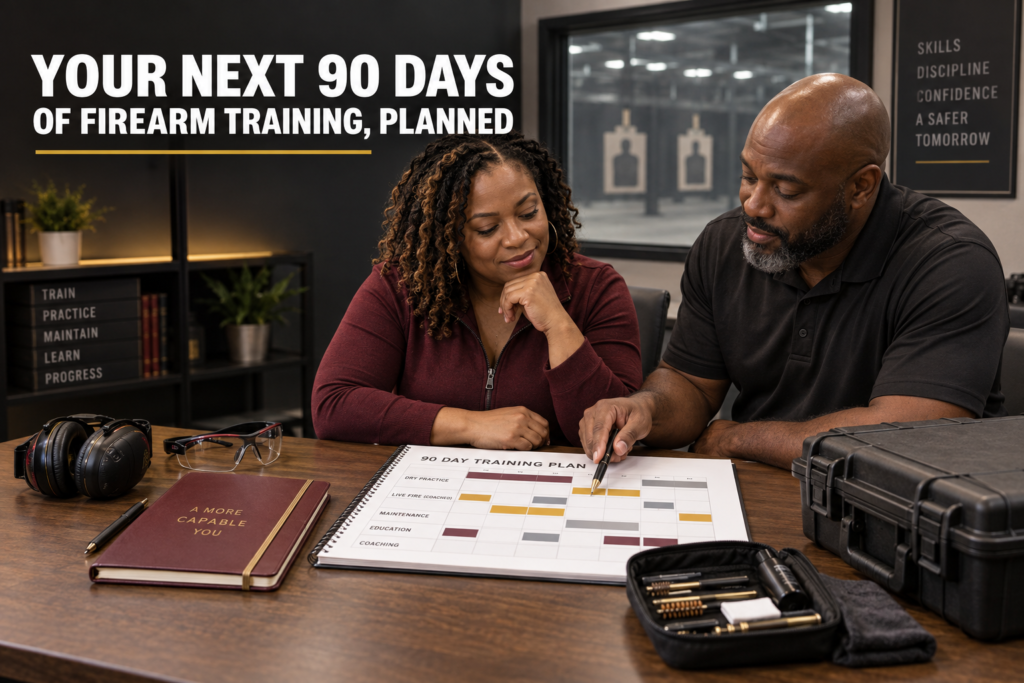
A 90-day firearm training plan can give that effort direction.
This is not a promise that you will become competent in every skill within 90 days. It is a framework for making safer, more deliberate decisions about what you practice, what you measure, and when you need instruction.
Your schedule, round count, and rate of progress should reflect your experience, health, equipment, access to training, and instructor feedback. There is no universal frequency or ammunition count that fits everyone.
The goal is not to rush. The goal is to stop guessing.
Build Your Plan Around Four Practice Lanes
A complete plan includes more than trips to the range.
1. Safe unloaded practice in a deliberately prepared environment
Unloaded practice can support skills you have already learned from a qualified instructor.
Before beginning, deliberately prepare the environment. Remove live ammunition from the practice area, eliminate distractions, choose a safe direction with an appropriate backstop, and confirm the firearm’s condition according to the process you were taught.
Do not use unsupervised practice to teach yourself an unfamiliar movement. If you are unsure how to unload, verify, handle, or practice with your firearm safely, begin with instruction.
2. Instructor-led classroom or dry-fire skill work
This lane lets you learn a process, receive corrections, and understand what safe practice should look like before adding live ammunition.
For permit holders working on concealment, Tribe’s Confident Carry Clinic Level 1 is a three-hour, instructor-led dry-fire class focused on drawing from the holster and related carry skills. Confirm the next available date on the live event schedule.
3. Coached live fire
Live fire gives you information that unloaded practice cannot. Recoil, sound, timing, target feedback, and the range environment all affect performance.
Private coaching is useful when you have one stubborn problem, need individual feedback, or want an instructor to establish a baseline. Tribe currently offers one-hour indoor and outdoor instructor-led range visits, plus multi-session range packages for owners who need continued coaching rather than a single visit.
4. Equipment care, storage review, legal education, and non-firearm decision skills
Responsible ownership includes knowing the condition of your equipment, reviewing how it is secured, and keeping up with the rules that apply where you live, travel, store, and carry.
This lane can also include situational awareness, de-escalation, home planning, and non-firearm protection options. Not every safety problem is a shooting problem.
Days 1–30: Assess and Rebuild Fundamentals
Primary training goal: Establish an honest baseline and rebuild the safest version of your core habits.
Start with what you can demonstrate now, not what you remember doing well six months ago.
Choose a small number of familiar fundamentals. Work only with skills that match your current level and environment. Record what feels reliable, what requires conscious effort, and where you need help.
Observable indicators:
- You can follow the safety process for the environment without rushing or improvising.
- You can identify one or two specific performance issues instead of saying, “I just need to get better.”
- Your equipment fits its intended use, is in serviceable condition, and does not force repeated adjustments during supervised work.
Suggested instructor touchpoint: Schedule private coaching early in the phase if you are nervous, returning after a long break, or unable to identify the cause of an issue. A permit holder who has never learned safe access from concealment may be better matched to Confident Carry I before attempting more complex carry work.
Maintenance or equipment check: Read the current owner manual. Inspect the firearm and magazines according to the manufacturer’s guidance. Confirm that your storage setup still protects against unauthorized access and fits your household. If takedown, cleaning, reassembly, lubrication, or storage causes uncertainty, Gun Owner Essentials is designed around learning those responsibilities with your own firearm.
Decision point: Repeat this phase if safe handling is inconsistent, the equipment remains unresolved, or you cannot name a clear training priority. Progress when your baseline is stable enough to measure and your instructor agrees that the next work is appropriate.
Days 31–60: Add Measurement and Consistency
Primary training goal: Turn general practice into repeatable sessions with useful records.
Measurement does not have to mean speed or competition. It can mean observing whether you followed the same process, whether the same problem appeared, and whether a correction held across multiple supervised attempts.
Pick indicators that match the skill and your level. Record the conditions so you do not compare unlike sessions.
Observable indicators:
- You arrive with one defined purpose instead of trying to practice everything.
- You can record a consistent measure such as target pattern, completion of the taught process, equipment comfort, or instructor-observed correction.
- Your notes show whether a result repeated across more than one session.
Suggested instructor touchpoint: Use a private range visit to check whether home practice is transferring safely to live fire. If continued feedback would help, Tribe’s three-session and five-session range packages provide a structured way to return for coaching. Current listed package prices range from $300 to $450. Verify the option, included timeframe, location, and booking terms on the product page before purchase.
Maintenance or equipment check: Check cleaning needs against the manufacturer’s instructions and your actual use. Inspect holster fit, mounting hardware, sights or optic, batteries where applicable, protective equipment, range bag contents, and storage-device operation. Do not modify safety-related equipment casually.
Decision point: Repeat the phase if your results change unpredictably, the same safety correction keeps returning, or your equipment interferes with consistent work. Progress when your observations are repeatable and an instructor confirms that added complexity is appropriate.
Days 61–90: Integrate Skills Appropriate to Your Verified Level
Primary training goal: Combine previously learned skills without exceeding your demonstrated level.
Integration does not mean making everything faster or harder. It means connecting safe, familiar skills in an environment built for them.
A permit holder may be ready to connect concealment work with coached live fire. An experienced owner may be ready for intermediate defensive-pistol work. A home defender may need to integrate storage, household communication, decision-making, and coached firearm access without following a carry-centered path.
Observable indicators:
- You maintain safe habits when more than one familiar task is combined.
- You can explain why the selected class or coaching session matches your present level.
- You recognize when to stop, simplify, ask a question, or return to a previous phase.
Suggested instructor touchpoint: Permit holders who have completed the required foundation may consider Confident Carry II, Tribe’s coached outdoor live-fire holster training. Intermediate students who meet all stated prerequisites may ask about APDT, Advanced Pistol Defensive Tactics. Confirm APDT’s current prerequisites, equipment requirements, ammunition requirements, price, and schedule directly with Tribe before enrolling.
Maintenance or equipment check: Review the entire system you will use in the next training environment. Confirm firearm condition, compatible equipment, secure storage, protective gear, and class-specific requirements. Review current official laws for every jurisdiction relevant to your plan.
Decision point: Repeat an earlier phase if integration causes safety, equipment, or fundamentals to deteriorate. Progress only when the next environment matches your verified skills, not simply because Day 90 arrived.
Three Example 90-Day Firearm Training Plans
These examples are routes, not prescriptions. An instructor may recommend a different order after seeing your current skills.
Permit Holder Rebuilding Confidence
Days 1–30: Begin with a private coaching assessment. Revisit safe handling, core shooting fundamentals, equipment fit, and the specific reason confidence dropped. Use Gun Owner Essentials if maintenance or familiarity with the firearm is part of the problem.
Days 31–60: Attend Confident Carry I if you need instructor-led work on drawing from concealment and related on-body carry skills. Continue only the safe unloaded practice you were taught. Use another private coaching session to check progress.
Days 61–90: If prerequisites are met and the instructor agrees, move to Confident Carry II for coached live-fire holster work. If you want a complete permit-holder pathway instead of booking separate sessions, consider the Advanced Carry Program. It currently combines three private range sessions, one private class, and two group classes for $697, with Afterpay and PayPal Later listed as checkout options.
Regular Owner Ready for Advanced Work
Days 1–30: Use private coaching to document a baseline and identify one performance priority. Confirm that safety, fundamentals, maintenance, and equipment are ready for more demanding work.
Days 31–60: Use a multi-session range package for continued feedback and measurable practice. Add Confident Carry I or II only if those carry-focused skills match your goals and you meet the stated prerequisites.
Days 61–90: Ask whether APDT is appropriate. APDT is not a substitute for missing fundamentals. It is intermediate defensive-pistol training for students who meet the course requirements. The Advanced Carry Program may be the better organized route for a current permit holder who wants carry-focused private and group training rather than one isolated advanced class.
Home Defender Who Does Not Intend to Carry
Days 1–30: Use private coaching to assess safe handling and live-fire fundamentals. Review the home storage plan, unauthorized-access risks, household communication, and the firearm owner’s manual.
Days 31–60: Attend Gun Owner Essentials for model-specific takedown, cleaning, maintenance, storage, and readiness work with your own firearm. Continue coached live fire as appropriate. Add legal education and non-firearm decision skills to the plan.
Days 61–90: Revisit the home plan and confirm that training, equipment, storage, and household roles work together. The Home Defender Program is Tribe’s complete beginner path for people who want responsible home protection without a carry-centered plan. It currently includes two private range sessions, one private class, and three group classes for $597. Afterpay and PayPal Later are listed as checkout options.
The Empowered Protector Program is different. It is for a beginner who needs the complete ownership-to-carry path, including permit education and continued skill development. It is not the automatic recommendation for an established owner or someone who does not intend to carry.
Missed Two Weeks? Use This Reset Rule
Do not punish yourself. Do not try to cram missed practice into one long session.
Return to the last phase in which you could perform the taught process safely and consistently.
Review your notes. Recheck your equipment and prepared practice environment. Begin with a familiar, low-complexity skill that you have already been taught. If you feel uncertain about safe handling, your firearm’s condition, or what you remember, stop and schedule an instructor touchpoint before continuing.
Your first session back is a baseline check, not a test of character.
After that check, decide whether to resume the phase, repeat part of it, or adjust the plan with your instructor.
Copy-Ready 90-Day Firearm Training Tracker
Copy this into your notes app, training journal, or calendar.
MY 90-DAY FIREARM TRAINING PLAN

Start date:
Primary ownership goal:
Current verified level:
Instructor or training contact:

PHASE 1: DAYS 1–30
Primary goal:
Practice lane used:
Date and type of session:
Skill or topic addressed:
Observable indicator 1:
Observable indicator 2:
Instructor feedback:
Maintenance/equipment check:
What needs to be repeated:
Decision: Repeat Phase 1 / Progress to Phase 2

PHASE 2: DAYS 31–60
Primary goal:
Practice lane used:
Date and type of session:
What I measured:
Conditions I recorded:
Observable indicator 1:
Observable indicator 2:
Instructor feedback:
Maintenance/equipment check:
What needs to be repeated:
Decision: Repeat Phase 2 / Progress to Phase 3

PHASE 3: DAYS 61–90
Primary goal:
Practice lane used:
Date and type of session:
Skills safely integrated:
Observable indicator 1:
Observable indicator 2:
Instructor feedback:
Maintenance/equipment check:
What needs to be repeated:
Decision: Repeat an earlier phase / Choose the next appropriate path

MISSED-TIME RESET
Last session date:
Last stable phase:
Baseline recheck date:
Instructor help needed:

NEXT 90 DAYS
One priority to continue:
One class or coaching touchpoint to schedule:
One equipment, storage, or education item to review:
Plan the Next Safe Step
Consistency does not mean forcing yourself through a rigid calendar. It means returning to a clear purpose, observing what is actually happening, and getting help before adding complexity.
Your 90-day firearm training plan should change when your skills, equipment, goals, or responsibilities change.
If you need help choosing between private coaching, a range package, Confident Carry, Gun Owner Essentials, APDT, or a complete program, call or text Tribe Defense Academy at 301-410-9220. Tell us your current experience, what you want to improve, and where you feel uncertain. We will help you build a path that fits your verified level.
You do not have to do everything in 90 days.
You need to take the next responsible step.
Frequently Asked Questions
How often should I train during a 90-day firearm training plan?
There is no universal schedule. Your frequency should reflect your current level, the skill being practiced, instructor guidance, safe access to an appropriate environment, and your ability to maintain quality. A realistic plan you can repeat is more useful than an aggressive plan you cannot sustain.
How much ammunition do I need for 90 days of training?
There is no single correct round count. Some phases may emphasize classroom education, unloaded practice, maintenance, storage, or decision-making. Ask your instructor or check the specific class page before purchasing ammunition for coached live fire.
Can I use dry practice instead of live-fire training?
Safe unloaded practice and live fire provide different feedback. Unloaded practice can reinforce skills you have already been taught, while live fire adds recoil, sound, target feedback, and range conditions. Your plan may use both, plus instruction and equipment care.
What if I have a concealed carry permit but do not feel ready to carry?
Do not rush. A permit course is one step, not proof that every carry skill is established. Private coaching and Confident Carry I may help identify and rebuild specific skills before live-fire holster work is considered.
When should I take Confident Carry II or APDT?
Take either only when you meet the current course prerequisites and an instructor agrees that the environment fits your demonstrated level. Confident Carry II adds coached live-fire holster work. APDT is intermediate defensive-pistol training and should not be used to skip missing fundamentals.
Which Tribe program is right for a beginner?
Empowered Protector is the complete ownership-to-carry path for a beginner who intends to carry. Home Defender is the complete beginner path for someone focused on responsible protection at home without a carry-centered plan. Call 301-410-9220 if you are unsure.