Share This Post
The box is home.
You may have selected a safe place to store it, read part of the manual, or watched a few videos. You may also be looking at the firearm and thinking, “What am I supposed to do now?”
That feeling is more common than you think.
Buying a gun does not automatically give you confidence, safe handling habits, or shooting skill. It gives you a piece of equipment. Learning how to use, store, maintain, and make responsible decisions with that equipment comes next.
You do not have to be embarrassed because you are nervous. You do not have to know firearm terminology before taking a class. You also do not have to rush to prove that you are comfortable.
At Tribe Defense Academy, we believe your first month should be patient, structured, and focused on building a safe foundation.
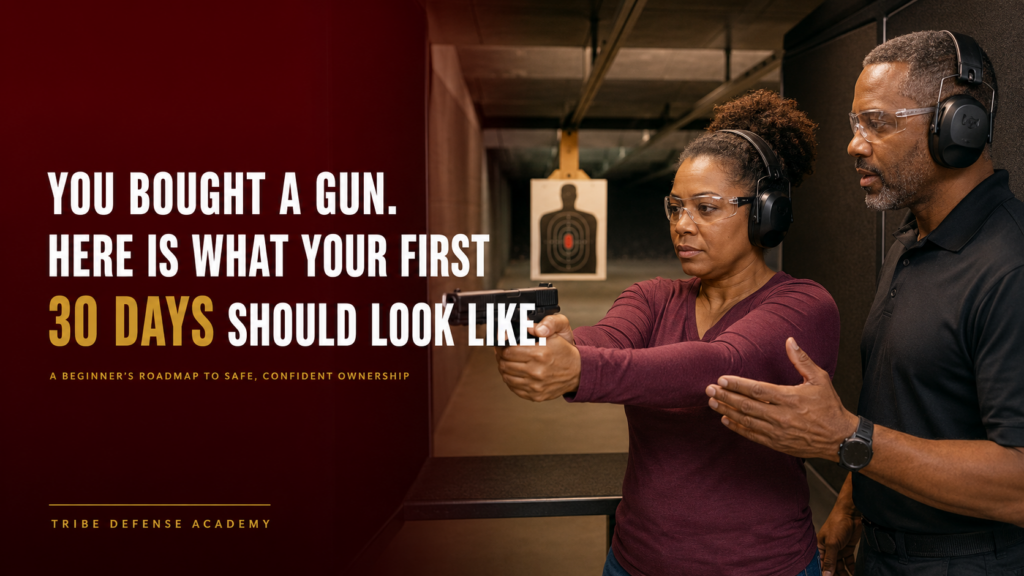
Here is what your first 30 days as a new gun owner can look like.
Week 1: Learn What You Own and How to Handle It Safely
Your first week is not about shooting fast. It is about becoming familiar with the firearm in a controlled environment.
Start with the basic safety rules. Learn how to keep the firearm pointed in a safe direction, keep your finger away from the trigger until you are prepared to fire, and confirm the firearm’s condition before handling it.
You should also learn the basic parts and controls of your specific firearm.
That includes understanding how to identify the muzzle, grip, trigger, magazine, slide, sights, magazine release, and any manual safety your firearm may have. Your firearm’s owner manual is an important resource because controls and operating procedures can differ between models.
A qualified instructor can show you how to:
- Confirm that the firearm is unloaded
- Hold and handle it safely
- Identify its major parts and controls
- Insert and remove a magazine
- Understand basic ammunition terminology
- Match the correct ammunition to the firearm
- Select an appropriate safe-storage method
- Prepare the firearm for lawful transportation
Any hands-on practice during this stage should be conducted with an unloaded firearm, no live ammunition in the practice area, and qualified guidance if you are not yet confident in your handling skills.
This is also the week to create a storage plan.
Your storage decision should consider who lives in or visits your home, including children, teenagers, relatives, contractors, and guests. Responsible storage should help prevent unauthorized access while supporting the purpose for which the firearm is kept.
Educational Legal Note
Firearm purchase, possession, registration, transportation, storage, and carry requirements vary by jurisdiction and may change.
Maryland residents should review current information from the Maryland State Police Licensing Division and its firearms frequently asked questions.
DC residents and anyone transporting or carrying a firearm in the District should consult the Metropolitan Police Department’s firearms resources, including its guidance on transporting firearms.
This information is educational and is not individualized legal advice. Always check the official rules that apply to your location and circumstances before transporting or carrying a firearm.
Week 2: Build the Fundamentals Without Pressure
During the second week, begin learning the physical skills involved in safe firearm use.
A beginner class or structured dry-practice session gives you a safer place to learn than trying to copy random drills from social media.
Dry practice means practicing firearm-handling skills without live ammunition. It should be done only after you understand how to unload and verify the firearm properly. The practice area should be free of live ammunition and have a safe direction or appropriate backstop.
Under qualified instruction, begin working on:
- Grip: How your hands hold and control the firearm
- Stance: How you position your body for balance and stability
- Sights: How you use the firearm’s sights to aim
- Trigger control: How you press the trigger without unnecessarily moving the firearm
- Loading concepts: How magazines and ammunition interact with the firearm
- Safe unloading: How to remove the ammunition source and verify the firearm’s condition
- Range etiquette: How to follow commands and handle equipment safely around other people
You are not trying to master everything in one week.
The goal is to understand the process well enough that you can follow instructions safely and begin repeating the correct movements.
If you feel nervous, say so. A good instructor would rather know that you are uncomfortable than watch you struggle silently.
Questions are welcome at Tribe. You will never be expected to pretend that you understand something you have not been taught.
Week 3: Attend a Coached Private Range Session
Your third week is a good time to take what you learned in the classroom or during dry practice and apply it during a coached private range session.
The range can feel overwhelming for a first-time shooter. It may be louder, busier, and more physically demanding than expected. Recoil, which is the firearm’s backward movement when fired, may also feel different from what you imagined.
Personalized coaching allows the instructor to focus on what you are actually doing.
A coach can help you:
- Maintain safe handling before, during, and after shooting
- Build a grip that supports better control
- Manage recoil more comfortably
- Improve accuracy without rushing
- Understand why shots may be landing away from the intended area
- Follow range commands and procedures
- Correct unsafe or inefficient habits before they become familiar
Small adjustments can make a significant difference.
A change in hand position may improve recoil control. A slower, smoother trigger press may improve accuracy. A reminder to breathe may help reduce tension.
This is why feedback matters early. Repeating an incorrect habit hundreds of times does not make it correct. It only makes the habit harder to change.
Your first coached range session should not be a competition. The goal is safe, controlled repetition and a clearer understanding of what to practice next.
Week 4: Choose the Path That Matches Your Purpose
By the fourth week, you should have a better understanding of your firearm, your current comfort level, and the skills that still need work.
Now you can choose a longer-term training path based on why you own or plan to own a firearm.
Path 1: Home Protection Without Carrying
You may want a firearm for protection inside your home but have no intention of carrying it in public.
Your continuing education should focus on safe storage, reliable access, firearm maintenance, family safety planning, decision-making, and continued coached practice.
Tribe’s Home Defender Program is designed for beginners who want a complete responsible-ownership path focused on protection at home without following a carry-centered training plan.
Owning a home-protection firearm should include more than placing it in a drawer or safe. You need a plan for securing it, accessing it responsibly, communicating with household members, and continuing to practice.
Path 2: Responsible Ownership Plus Concealed Carry
You may want to become a responsible firearm owner and eventually pursue lawful concealed carry.
That path requires both administrative education and continued skill development. A permit course can address required material, but carrying responsibly also involves selecting appropriate equipment, understanding applicable laws, practicing safe concealment, and developing skills beyond minimum qualification standards.
Tribe’s Empowered Protector Program is designed for beginners who want a complete path that includes responsible firearm ownership and concealed carry education.
Before carrying, review the current official rules for every jurisdiction where you intend to possess, transport, or carry the firearm.
Maryland permit information is available from the Maryland State Police Wear and Carry Permit page. DC concealed carry information is available through the Metropolitan Police Department’s concealed carry resources.
Permit requirements and carry restrictions can differ between Maryland and DC. Completing training in one jurisdiction does not automatically mean you understand or satisfy the requirements of another.
Path 3: Continued Confidence With an Existing Permit
Some people complete a permit class and then realize they still do not feel comfortable handling, shooting, or carrying their firearm.
That does not mean you failed. It means you need continued practice.
Tribe’s Advanced Carry Program is a next-stage option specifically for current permit holders who want to improve their existing skills through additional instruction and coached practice.
It is not the starting program for someone who is completely new and still needs beginner education.
Passing a permit course demonstrates that you completed a required training step. It should not be treated as the end of your skill development.
Do Not Rush This
Do not buy a pile of accessories before you understand your needs.
A holster, optic, light, storage device, or other accessory should fit your firearm, your intended use, and your current skill level. Training can help you make better purchasing decisions.Do not practice unsafe internet drills.
A drill may look impressive online while leaving out important safety steps, experience requirements, or environmental controls. Learn movements from a qualified instructor before attempting them independently.Do not begin carrying before you understand the laws and your equipment.
Carrying requires more than owning a firearm and purchasing a holster. You need lawful authority, appropriate equipment, safe handling habits, and an understanding of where and how carry is restricted.Do not assume a permit class completes your development.
Permit education is one part of a larger training process. Safe handling, accuracy, decision-making, concealment skills, and consistent practice develop over time.
Your 30-Day Confidence Checklist
This checklist is not a claim of mastery. It is a way to observe your progress and identify what you still need to practice.
By the end of your first 30 days, see whether you can:
- Recite the basic firearm safety rules in your own words
- Identify the muzzle, trigger, grip, magazine, sights, and major controls
- Locate and use the owner manual for your specific firearm
- Explain how you confirm the firearm is unloaded
- Keep your finger away from the trigger during routine handling
- Keep the firearm pointed in a safe direction during supervised practice
- Identify the correct ammunition listed for your firearm
- Explain your home storage plan and who it is designed to protect
- Find the official transportation guidance for your jurisdiction
- Demonstrate a basic grip and stance under instructor supervision
- Follow range commands without guessing
- Load and unload under direct supervision
- Fire controlled shots while maintaining safe handling
- Identify at least one habit that needs more practice
- Explain whether your long-term goal is home protection, concealed carry, or continued skill development
- Schedule or select your next appropriate training step
If you cannot check every box, that is okay.
The purpose of the checklist is to show you what comes next, not to make you feel behind.
Your First Month Is the Beginning
The most responsible new gun owners are not always the people who appear fearless.
They are the people willing to slow down, ask questions, accept coaching, and practice the basics correctly.
Your firearm does not need to remain untouched because you are nervous. It also should not be handled casually because you are eager to feel prepared.
There is a safer middle ground: structured training.
Depending on your experience and goals, your next step may be:
- An individual beginner class for foundational education
- A Try Before You Buy session if you have not purchased yet or want to compare firearms before choosing
- Private range coaching for personalized live-fire instruction
- A complete training path through Empowered Protector, Home Defender, or Advanced Carry
Not sure which option fits you?
Call or text Tribe Defense Academy at 301-410-9220. Tell us what experience you have, what makes you nervous, and what you want to be able to do. We will help you choose a starting point without judgment or pressure.
You do not have to know everything before you begin.
You only need to take the next safe step.
Frequently Asked Questions
1. Should I go directly to the range after buying my first gun?
A coached beginner class or private session is usually a better starting point if you do not yet understand the firearm’s controls, safe loading and unloading, or range commands. Building a foundation first can make your initial live-fire experience safer and less overwhelming.
2. What if I already bought a firearm that feels uncomfortable?
Do not assume you have to force yourself to become comfortable with it. A qualified instructor can evaluate your grip, hand fit, control, and technique. If the firearm is not a good match, a Try Before You Buy session can help you compare other options before purchasing again.
3. Can I practice at home during my first month?
Structured dry practice may be useful, but only after you have been taught how to unload and verify your firearm safely. Remove live ammunition from the practice area, choose a safe direction, eliminate distractions, and practice only skills you understand.
4. Does completing a concealed carry permit class mean I am ready to carry?
A permit class is an important educational and legal step, but it does not complete every aspect of firearm skill development. Continued instruction may be needed for safe concealment, equipment selection, accuracy, drawing, decision-making, and regular practice.
5. Which Tribe program is right for me?
Empowered Protector is for beginners who want a complete path toward responsible ownership and concealed carry. Home Defender is for beginners focused on protection at home without a carry-centered path. Advanced Carry is the next-stage option for people who already hold a permit and want continued skill development. Call 301-410-9220 if you need help choosing.