
Share This Post
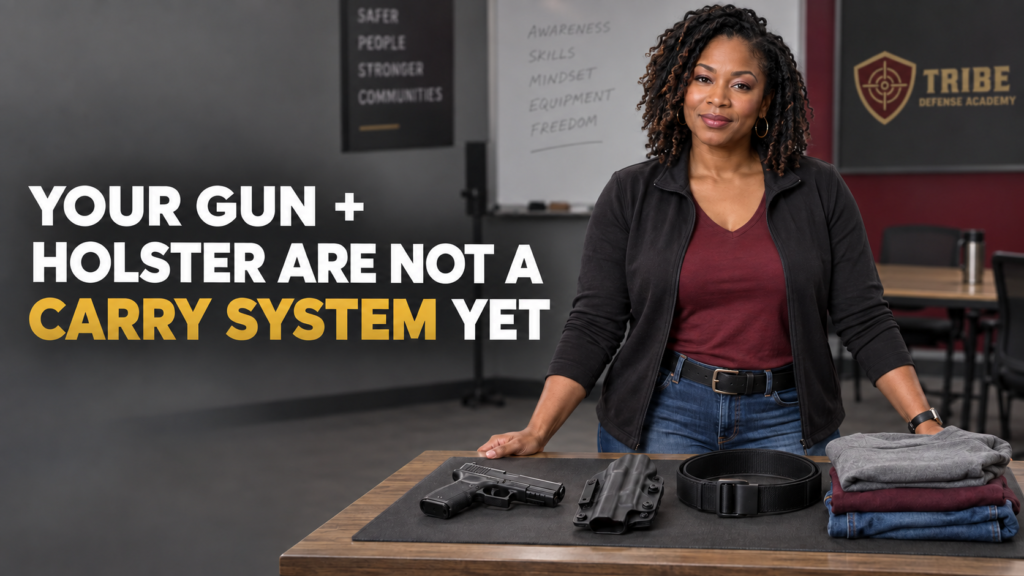
You bought the firearm. You bought the holster. You may have even bought a belt that promised to change your life.
That still does not mean you have a working concealed carry system.
A carry system is the way your firearm, holster, support system, clothing, body, daily activities, storage plan, and training work together. Every part affects the others. A safe holster can still become a poor setup if it shifts on an inadequate belt. A secure setup can still fail if your normal clothing interferes with it. A comfortable setup can still create safety problems if you constantly touch it, adjust it, or handle the firearm unnecessarily.
This is not about owning the fanciest gear. It is about finding out whether the equipment you already own can safely survive a normal day.
Before carrying, confirm that you are legally permitted to possess and carry your firearm and that you understand the rules for every jurisdiction and destination involved in your day. Laws and property rules can change. Maryland permit holders should review current Maryland law, including location restrictions. Anyone carrying in Washington, DC should review the current DC concealed carry restrictions and other firearms guidance from DC Metropolitan Police.
This article provides general safety and planning information. It is not individualized legal advice.
From Morning to Night: Does Your Carry System Actually Work?
1. Safe Preparation Before Leaving Home
The beginning of the carry day should be calm, deliberate, and boring. That is a compliment.
Administrative handling means handling the firearm for reasons other than responding to an immediate threat. Preparing it for carry, inspecting it, placing it into or removing it from a holster, and storing it are examples. These moments deserve your full attention and an appropriate environment.
Common failure point: Getting dressed while distracted, rushed, or surrounded by people, then repeatedly handling the firearm because the setup was not planned in advance.
Safer planning question: Where and when can I prepare my system with privacy, good lighting, no unnecessary distractions, and a safe plan for the firearm throughout the process?
Test only in controlled training: Any handling skill you cannot perform confidently, including working with your firearm and holster as a complete unit. Learn and practice with a qualified instructor before adding time pressure, live ammunition, or real-world carry.
Your morning should not become a daily equipment experiment. Make clothing and gear decisions before you are late and looking for your keys.
2. Holster Condition, Coverage, Retention, Attachment, and Compatibility
A holster is not safe simply because your firearm fits inside it.
It should be in good condition, properly matched to the firearm, and designed to protect the trigger area from unintended access. It should retain the firearm as intended and remain attached to the support system during normal movement. Lights, optics, aftermarket controls, and other changes can affect compatibility. Follow the firearm and holster manufacturers’ current instructions.
Common failure point: Assuming that “it clicks” or “it fits” automatically means the holster provides proper trigger-guard coverage, retention, and compatibility.
Safer planning question: Does this holster securely support my exact firearm and its current configuration without damage, unwanted movement, or access to the trigger area?
Test only in controlled training: Retention during vigorous movement, access from concealment, and any draw or reholstering work. These tests belong in an appropriate training environment under qualified supervision, not in a bedroom mirror with a loaded firearm.
Inspect the holster regularly. Cracks, loose hardware, worn attachment points, trapped debris, and damaged retention components are not personality quirks. They are problems.
Comfort Is Not the Same as Safety
A setup can feel soft, flexible, or barely noticeable and still fail to protect the trigger area, hold the firearm securely, or remain attached during movement.
The reverse can also be true. A secure setup may be uncomfortable because it is positioned poorly for your body or paired with the wrong clothing or support system. Pain, numbness, sharp pressure, and restricted movement are not things you should simply “get used to.” They are signals that the system needs to be evaluated.
Comfort matters because a miserable setup usually gets adjusted, removed, left at home, or replaced without much thought. Safety comes first, but a practical carry system must support both safety and sustainable daily use.
3. Belt or Support System and Clothing Interaction
Your holster does not work alone. Its attachment must cooperate with your belt or other support system, waistband, clothing, and body.
No single carry position, firearm, holster, or belt works for everyone. Body shape, mobility, daily clothing, medical needs, work demands, and lawful access all matter.
Common failure point: Testing each item separately but never checking how the complete setup behaves when worn together.
Safer planning question: Does my support system keep the holster stable and properly oriented with the clothing I actually wear?
Test only in controlled training: How garments interact with safe access, how the attachment behaves during movement, and whether a clothing change introduces interference. Do this with instructor guidance and without turning your living room into an unsupervised holster clinic.
If the setup only works with one pair of pants you last wore in 2019, you do not have a daily system. You have a special-occasion arrangement.
Do Not Let the Internet Pick Your Entire Setup
Online reviews can help you learn what options exist. They cannot evaluate your body, your firearm, your mobility, your wardrobe, or your daily routine.
A creator’s favorite setup may be safe and effective for that creator. That does not make it automatically appropriate for you. Be especially cautious with advice that ignores firearm compatibility, trigger protection, retention, attachment security, training, or manufacturer guidance.
Use online content to create better questions, not to outsource the entire decision.
4. Sitting, Standing, Bending, Driving, and Ordinary Transitions
Most of a carry day is not spent standing perfectly still in front of a mirror.
You sit in the car. You reach for a bag. You bend to tie a shoe. You move between indoor and outdoor spaces. You use the restroom. You may carry children, groceries, work equipment, or all three because apparently you enjoy a challenge.
Common failure point: Choosing a setup based only on how it looks while standing, then discovering that it shifts, becomes exposed, creates pressure, or conflicts with the seat belt and clothing during ordinary movement.
Safer planning question: Can this system remain secure, concealed when required, and manageable through the transitions that are actually part of my day?
Test only in controlled training: Dynamic movement, access from non-standing positions, vehicle-related access, and responses to unexpected exposure or equipment movement. These scenarios require an unloaded or purpose-built training setup as directed by a qualified instructor, followed by supervised progression when appropriate.
Restroom use deserves a plan too. The goal is to maintain control of the system, prevent unauthorized access, and avoid unnecessary firearm handling. Work through the issue with an instructor who can discuss options appropriate to your equipment and clothing.
5. Maintaining Concealment Without Constant Adjusting
If you keep checking, patting, tugging, or adjusting the firearm, you may be drawing more attention to it while increasing unnecessary contact with the system.
Some people do this because the setup feels unfamiliar. Others do it because the equipment is genuinely moving. Those are different problems, but neither should be ignored.
Common failure point: Touching the firearm every few minutes for reassurance instead of confirming that the system is stable before entering public space.
Safer planning question: Can I trust this setup to remain stable through normal activity without repeatedly touching it?
Test only in controlled training: Garment movement, concealment through activity, and what to do if the system shifts or becomes exposed. Practice the decision-making with an instructor before trying to improvise in public.
“Nobody noticed” is not the only standard. You also need to know that the holster stayed attached, the firearm stayed secure, and the trigger area remained protected.
6. Safe Storage When Carry Is Not Permitted or Practical
Your day may include a prohibited location, a property with restrictions, an activity where carrying is impractical, or travel across a jurisdictional line. Finding that out after you arrive is not a storage plan.
Maryland and DC do not have identical carry rules. Private property rules and the laws of every jurisdiction you enter may also apply. Verify restrictions through current official government sources before leaving home. If you are unsure how the law applies to your circumstances, consult a qualified attorney.
Common failure point: Arriving somewhere the firearm cannot lawfully or practically go, then making a rushed decision in a vehicle or parking lot.
Safer planning question: What lawful, secure, access-controlled storage option will I use if my route or destination does not allow carry?
Test only in controlled training: Transitions between lawful carry and storage when those transitions involve firearm handling. Ask an instructor to help you develop a process that reduces exposure, distraction, and unnecessary handling while following applicable law and manufacturer instructions.
A glove compartment is not a universal answer. Neither is hiding the firearm under something and hoping nobody sees it. Storage must account for theft, unauthorized users, children, vehicle rules, and the specific laws that apply.
7. Returning Home and Ending the Carry Day
The end of the day is where fatigue likes to pretend it is efficiency.
You are home. You are tired. The phone is ringing. Somebody needs dinner. This is exactly when you should resist rushed or unnecessary handling.
Common failure point: Removing or manipulating the firearm casually while distracted, then leaving it unsecured because “I was about to put it away.”
Safer planning question: What consistent end-of-day plan lets me secure the firearm immediately, limit handling, and prevent access by unauthorized people?
Test only in controlled training: Any holster removal, firearm handling, unloading, or storage transition you cannot complete confidently and safely. Get direct supervision before making it part of your daily routine.
The best end-of-day process is not the most dramatic one. It is the one you can follow calmly and consistently.
Why Reholstering Deserves Patience
Reholstering is an administrative task, not a speed contest.
There is rarely a prize for getting the firearm back into the holster quickly. Clothing, drawstrings, damaged equipment, body position, and other objects can interfere with the process. That is why reholstering deserves visual attention, patience, and a controlled environment.
We are intentionally not giving public step-by-step reholstering instructions here. The safe technique depends on the firearm, holster, carry method, body position, and environment. Learn it directly from a qualified instructor who can see what you are doing, correct problems, and stop the process if something is unsafe.
If anything feels wrong, rushed, obstructed, or uncertain, stop. Speed can wait. Safety cannot.
Maintenance Is Part of Reliability
Your carry system collects lint, sweat, dust, moisture, makeup, food crumbs, and mysterious pocket debris that apparently appears through magic.
Maintenance is not only about cleaning the firearm. It also includes inspecting the holster, attachment hardware, belt or support system, magazines, and any authorized accessories. Follow the manufacturers’ current inspection, cleaning, lubrication, service, and replacement guidance.
Common failure point: Maintaining the firearm while ignoring loose holster hardware, worn attachments, blocked components, corrosion, or changes in fit.
Safer planning question: What inspection schedule do the manufacturers recommend, and what changes mean this equipment should be serviced or replaced?
Test only in controlled training: Function checks or live-fire reliability testing that you have not been trained to perform. Use the correct environment and qualified supervision.
Reliable equipment still requires a trained person using it responsibly. Clean gear cannot make decisions for you.
Which Tribe Training Fits Which Part of the System?
Buying more equipment is not always the next answer. Sometimes the missing piece is supervised practice.
Confident Carry I
Confident Carry I focuses on the dry-fire side of carrying, including working with concealment and building safer, more consistent holster skills in a controlled classroom environment. It is a logical place to evaluate how your firearm, holster, clothing, and support system interact before adding live ammunition.
See current dates and details on Tribe’s Upcoming Classes and Events.
Gun Owner Essentials
Gun Owner Essentials helps owners better understand their handgun, safe handling, firearm function, loading and unloading, and maintenance. It addresses the firearm-care and confidence gaps that a holster class alone cannot fix.
Review the verified Gun Owner Essentials class page.
Private Coaching
Private coaching is useful when your equipment, body, schedule, clothing, or confidence requires individual attention. An instructor can observe the complete system, identify issues that are difficult to spot alone, and help you choose the appropriate next training step.
Explore Tribe’s training options or call or text 301-410-9220 to discuss the right fit.
Confident Carry II
Confident Carry II moves appropriate students into supervised live-fire holster training. It addresses the point where safe, established dry-fire skills must work with recoil, accuracy, and range conditions.
Confident Carry II is not the place to discover for the first time that your holster, belt, clothing, and firearm do not cooperate. Confirm the current prerequisites, required equipment, and class details before registering through Tribe’s Upcoming Classes and Events.
For permit holders who want a broader training path instead of piecing together individual classes, review Tribe’s Full Training Programs.
Your Permit Was the Beginning
Passing a permit class proves that you met a requirement at a particular point in time. It does not automatically prove that your daily carry system works while you drive, bend, sit, manage clothing, enter restricted locations, store the firearm, and return home tired.
Your firearm and holster become part of a carry system only after the entire setup has been evaluated, maintained, and tested through appropriate supervised training.
You do not need the internet’s favorite gun. You do not need the most expensive belt. You do need a system that is lawful, secure, compatible, sustainable for your real life, and supported by skill.
Ready to test more than your shopping receipt? Explore Tribe Defense Academy classes or call or text 301-410-9220 for help choosing the right training.
Copy-Ready Carry-System Checklist
Use this checklist to identify questions for a qualified instructor. It is not a substitute for training or legal guidance.
Before Leaving Home
- I have confirmed that my permit and firearm status allow lawful carry for today’s jurisdictions.
- I checked my route and destinations against current official location restrictions.
- I have a calm, private, well-lit plan for necessary administrative handling.
- I can secure the firearm from unauthorized access at home.
Firearm and Holster
- The holster is intended for my exact firearm and current configuration.
- The trigger area is protected from unintended access.
- The firearm is retained as the holster manufacturer intends.
- The holster and attachment show no cracks, damage, loose hardware, or trapped debris.
- I have reviewed the firearm and holster manufacturers’ current instructions.
Support System and Clothing
- The holster remains securely attached to the belt or support system.
- My clothing does not interfere with the trigger area, holster, or attachment.
- The complete setup remains stable through normal sitting, standing, bending, and walking.
- I have addressed driving, restroom use, and other routine transitions.
- I can maintain concealment without repeatedly touching or adjusting the system.
Storage and Daily Transitions
- I know where carry is restricted along today’s route.
- I have a lawful, secure, access-controlled storage plan when carry is not permitted or practical.
- My storage plan considers children, unauthorized users, theft, and vehicle access.
- I have a consistent end-of-day plan that avoids rushed or unnecessary handling.
Training and Maintenance
- A qualified instructor has evaluated the complete system.
- I practice access and reholstering only in an appropriate controlled environment.
- I do not add speed, movement, unusual positions, or live fire before I am ready and properly supervised.
- I follow current manufacturer guidance for inspection, cleaning, lubrication, service, and replacement.
- I schedule continued training instead of treating the permit as the finish line.
Frequently Asked Questions
1. What makes a firearm and holster a complete carry system?
A complete system includes the firearm, compatible holster, secure attachment, belt or other support system, clothing, lawful storage plan, maintenance plan, and the trained person using it. The parts must work together through the activities that make up your actual day.
2. Is the most comfortable holster automatically the best choice?
No. Comfort matters, but it does not replace trigger-area protection, retention, compatibility, secure attachment, good condition, and safe use. A setup should be evaluated for both safety and sustainable daily wear.
3. Can I test my concealed carry setup at home?
Some basic fit and clothing observations may be appropriate with a verified unloaded or purpose-built training setup, following manufacturer guidance and the direction of a qualified instructor. Drawing, reholstering, movement, unusual positions, and any work involving live ammunition should be learned and tested in an appropriate controlled training environment. If you are unsure, do not improvise.
4. What should I do if my destination does not allow firearms?
Check current laws and property rules before leaving home. Plan a lawful, secure, access-controlled storage option that accounts for theft and unauthorized users. Because the answer depends on jurisdiction and circumstances, consult current official sources and a qualified attorney when needed.
5. Which Tribe class should I take first?
It depends on the gap. Gun Owner Essentials supports firearm knowledge, safe handling, and maintenance. Confident Carry I addresses controlled dry-fire carry and holster skills. Private coaching offers individualized evaluation. Confident Carry II provides supervised live-fire holster training for students who meet its current prerequisites. Contact Tribe at 301-410-9220 if you are unsure which starting point fits.