
Share This Post
Most people assume they’ll know what to do if something bad happens.
A break-in.
A violent encounter.
A fire.
A medical emergency.
Ask most families what their emergency plan is and the answer usually sounds something like:
“We’ll call 911.”
That’s not a plan.
That’s a phone call.
The problem is that emergencies don’t happen when everyone is calm, focused, and thinking clearly. They happen when people are scared, confused, half asleep, and under stress.
When fear enters the room, preparation matters.
The families who respond effectively during emergencies are rarely making things up as they go. They’ve already discussed what happens next.
They’ve created a plan before they needed one.
Why This Matters
Stress changes everything.
Studies consistently show that under stress, people experience tunnel vision, memory issues, communication breakdowns, and delayed decision making.
That means the plan you think you’ll come up with in the moment often disappears when the moment actually arrives.
Imagine hearing glass break downstairs at 2:00 AM.
What happens next?
Does one person investigate?
Who calls 911?
Where do the kids go?
What room becomes the safe room?
What code word signals danger?
What happens if family members are separated?
Most people have never discussed these questions.
The result is confusion, hesitation, and potentially dangerous mistakes.
A family safety plan isn’t about living in fear.
It’s about removing uncertainty.
Tony’s Thoughts
One of the biggest mistakes I see is people spending thousands of dollars on equipment while spending zero time developing a plan.
They buy firearms.
They buy security cameras.
They buy alarm systems.
Then they assume that’s enough.
Equipment is valuable, but equipment without a plan creates false confidence.
If your family doesn’t know where to move, who to call, how to communicate, or what their responsibilities are during an emergency, you’re relying on luck.
Luck is not a strategy.
Prepared families assign roles before the emergency happens.
Everyone understands their responsibilities.
Everyone knows what success looks like.
The goal isn’t to create superheroes.
The goal is to create clarity.
Practical Breakdown
A simple family safety plan should address several key areas.
Communication
Every family should have clear communication procedures.
Create code words for emergencies.
Establish who contacts emergency services.
Discuss what information should be provided to first responders.
Keep emergency contacts easily accessible.
Movement
Where should family members go during an emergency?
Many families benefit from identifying a designated safe room.
Children should know exactly where to move if they hear a specific command.
The fewer decisions people have to make during an emergency, the better.
Responsibilities
Assign responsibilities in advance.
Who grabs the phone?
Who checks on children?
Who secures doors?
Who communicates with emergency responders?
Everyone should understand their role.
Medical Preparedness
Emergencies are not always violent encounters.
Medical emergencies are far more common.
Keep medical supplies available.
Know basic first aid.
Discuss where emergency supplies are stored.
Regular Practice
The best plan in the world is useless if nobody remembers it.
Review your plan regularly.
Practice simple scenarios.
Walk through emergency responses as a family.
Preparation creates familiarity.
Familiarity reduces panic.
Real World Application
Think about fire drills.
Nobody waits for a fire to start before deciding where the exits are.
Nobody says, “We’ll figure it out when it happens.”
We understand that preparation saves lives.
Home defense and personal safety deserve the same mindset.
You don’t need fear.
You need a framework.
You need communication.
You need a plan that everyone understands.
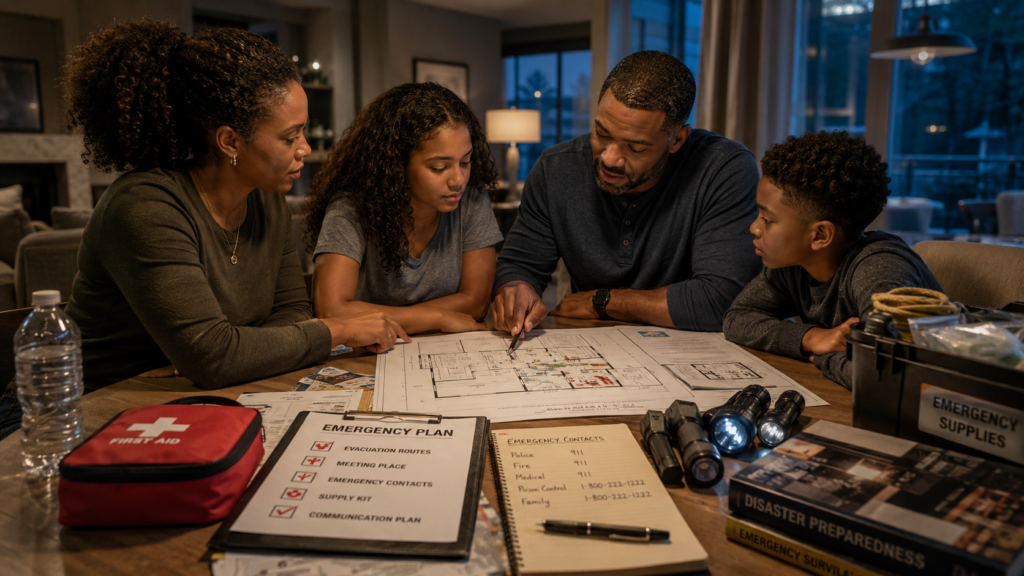
Even a simple conversation around the dinner table can dramatically improve your family’s preparedness.
The goal isn’t perfection.
The goal is progress.
Shani’s Perspective
Let me tell you what most families actually do.
They buy a gun.
Put it in a drawer.
Tell themselves they’re protected.
Then never talk about anything else.
Meanwhile, the kids don’t know what to do.
The spouse doesn’t know what to do.
The dog is probably the only one with a game plan.
We laugh about it, but this happens all the time.
People think buying safety equipment automatically creates safety.
It doesn’t.
Safety comes from preparation.
A firearm can be part of a plan.
An alarm system can be part of a plan.
Pepper spray can be part of a plan.
But none of those things are the plan.
The plan is the conversation.
The plan is the practice.
The plan is making decisions before emotions take over.
Why Training Changes Everything
Most people have never been taught how to think through emergency situations.
Training provides structure.
Training helps identify blind spots.
Training helps families understand realistic options instead of relying on Hollywood scenarios.
At Tribe Defense Academy, we spend a lot of time helping people build confidence through preparation.
The goal isn’t paranoia.
The goal is readiness.
When people understand their options, they become calmer, more capable, and more confident.
Prepared families don’t eliminate emergencies.
They eliminate unnecessary confusion.
Train With Tribe
If you’ve never sat down and created a family safety plan, now is the time.
Our Home Protection Defense Tactics class helps individuals and families think through realistic home protection scenarios, communication plans, movement strategies, and emergency decision making.
Because when something unexpected happens, your family deserves more than panic and guessing.
Your family deserves a plan.