
Share This Post
If you’ve ever felt lost in a firearms conversation, chances are ammunition was the moment things went left. People start throwing around words like round, bullet, caliber, hollow point, FMJ, and suddenly you’re nodding along while silently thinking…yeah, I don’t know what they’re talking about. And you’re not alone. A lot of confusion around firearms starts with ammunition. Once you understand what each part is called and what it actually does, everything else clicks into place. Training feels less intimidating, range time makes more sense, and you start asking better questions instead of guessing. Ammo knowledge is foundational, especially for new gun owners who want to feel confident instead of overwhelmed.
Let’s break it down in plain language.
Bullet vs Round: Words Matter
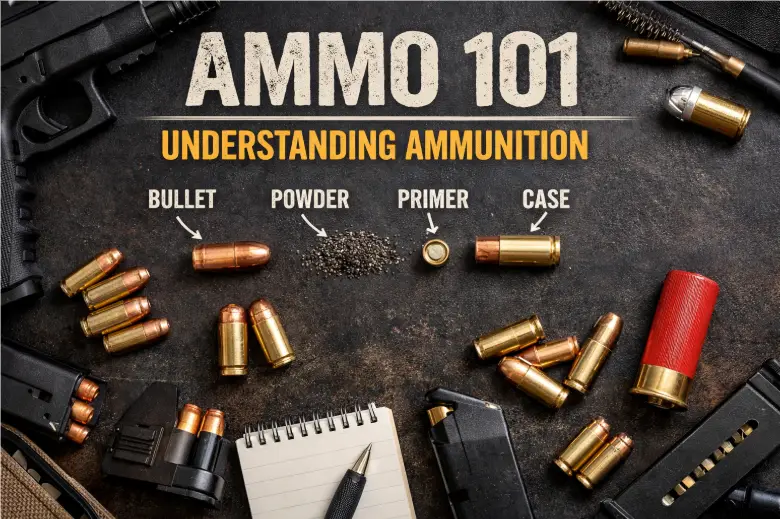
One of the most common misunderstandings we see in class is the difference between a bullet and a round. People use the words interchangeably, but they are not the same thing. The bullet is only the projectile. It’s the part that actually travels down the barrel and exits the firearm when you press the trigger. A round is the complete unit of ammunition. It includes the bullet, the case, the powder, and the primer. When someone says they loaded a magazine with 10 rounds, they’re talking about complete units of ammunition, not just bullets. This distinction matters because training instructions, safety rules, and firearm function all rely on correct terminology. Once you understand that, conversations stop feeling like a foreign language.
The Basic Components of Ammunition
Every modern cartridge-based round has four main components, and each one plays a specific role.
The bullet is the projectile. It’s usually made of lead or a lead core with a copper jacket, and it’s designed to travel accurately toward a target once fired.
The primer is the ignition source. When the firing pin strikes the primer, it creates a small spark that ignites the powder inside the case.
The powder is the propellant. It burns rapidly, creating pressure that pushes the bullet forward through the barrel. This is controlled combustion, not an explosion, which is an important distinction for understanding firearm mechanics.
The case, sometimes called the cartridge, holds everything together. It contains the primer, powder, and bullet. After the firearm fires, the empty case is ejected from the gun.
Once you understand these parts, it becomes easier to follow safety briefings, maintenance instructions, and loading demonstrations without feeling lost.
Caliber Explained Without the Confusion
Caliber refers to the size of the bullet and the firearm barrel. It’s often expressed in millimeters or inches, and this is where many new gun owners start to get overwhelmed. The key thing to understand is that firearms are designed to use specific calibers, and ammunition must match the firearm exactly.
Common handgun calibers include 9mm, .380 ACP, .40 S&W, and .45 ACP. Each caliber has different recoil, capacity, and performance characteristics. 9mm is one of the most popular calibers for beginners because it offers manageable recoil, affordable ammo, and wide availability. .380 ACP is smaller and often used in compact pistols, while .45 ACP is larger and heavier, typically producing more recoil.
Rifle calibers work differently and are designed for longer distances and higher velocities. Common examples include .223/5.56, .308, and .300 Blackout. Shotguns use gauges instead of calibers, with 12 gauge being the most common for home defense and sport shooting.
Understanding caliber helps you buy the correct ammo, train safely, and avoid dangerous mistakes. Using the wrong caliber is not just ineffective, it can be unsafe.
Ammo Types and What They’re Used For
Not all ammo is created equal, and different types serve different purposes. One of the most common questions we hear is, “What ammo should I practice with versus what should I carry?”
Full Metal Jacket, often called FMJ, is commonly used for training and range practice. These rounds are typically more affordable and feed reliably in most firearms. They are not usually recommended for defensive use because they can overpenetrate.
Hollow point ammunition is designed to expand upon impact. This expansion helps limit overpenetration and increases stopping effectiveness, which is why hollow points are commonly chosen for personal defense.
There are also specialty rounds like frangible ammo, which is designed to break apart on impact, and dummy rounds, which contain no primer or powder. Dummy rounds are especially important in training environments.
Why Dummy Rounds Matter in Training
In our Gun Owners Essentials class, we use dummy rounds to teach safe loading, unloading, and magazine manipulation without live ammunition. This allows students to focus on technique without the stress or risk of live fire. Dummy rounds are invaluable for learning how magazines work, how to load efficiently, and how to clear malfunctions safely.
Many new gun owners are surprised by how much confidence they gain just from learning how to handle ammunition correctly. Being able to load a magazine smoothly, understand what your firearm is doing, and recognize what’s happening internally builds real competence. It’s one of those skills that looks simple until you try it without guidance.
Ammo and Different Firearms
Handguns, rifles, and shotguns all use ammunition differently. Semi-automatic handguns rely on magazine-fed ammunition and cycling energy from the fired round to chamber the next one. Rifles often use higher-pressure rounds designed for distance and precision. Shotguns fire shells that contain pellets or slugs depending on the intended use.
Understanding how ammo interacts with your specific firearm helps with troubleshooting, maintenance, and training progression. When something doesn’t feel right, ammo knowledge often explains why.
Confidence Comes From Understanding
Ammo knowledge isn’t about memorizing specs or trying to sound like the smartest person at the range. It’s about knowing enough to train safely, ask the right questions, and handle your firearm without second-guessing yourself. That kind of confidence comes from doing, not guessing. That’s exactly why ammunition is built into our Gun Owners Essentials class.
You bring your unloaded firearm and a magazine, and we break ammo down hands-on, answer real questions, and show you quick, practical ways to load magazines using dummy rounds. We don’t stop there…we also teach you how to clean and maintain your firearm properly, then finish with a laser-assisted dry fire session so you know how to practice safely and correctly at home.