
Share This Post
Before the timer came out, the student looked comfortable.
She listened to the instructions, prepared carefully, and completed each step without rushing. Her handling was controlled. Her shots were accurate. Nothing about the exercise seemed beyond her ability.
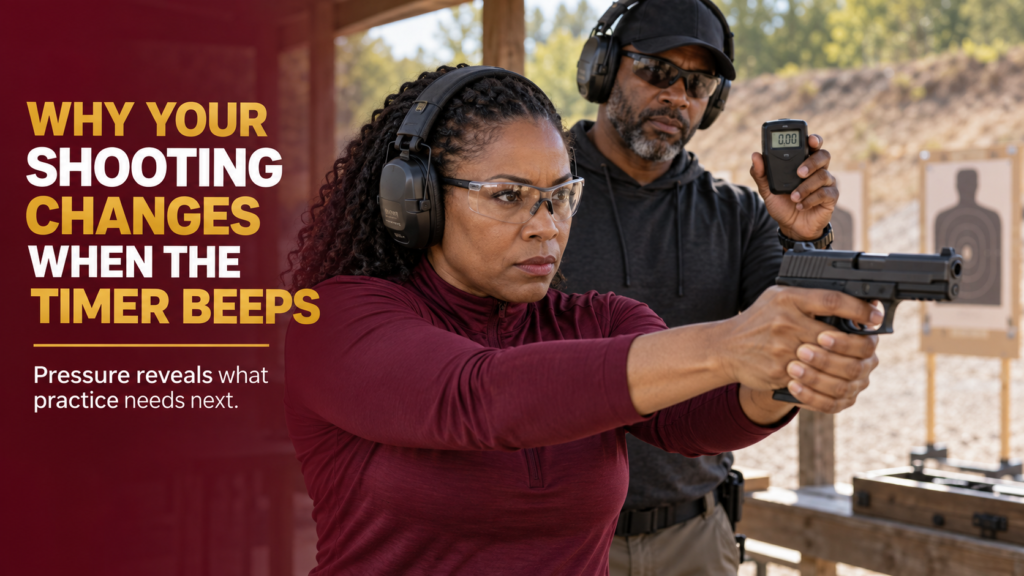
Then the instructor added a shot timer.
At the beep, everything changed.
She rushed her setup. Her grip felt different. She held her breath and tried to move faster than she had practiced. Instead of focusing on the visual information in front of her, part of her attention stayed on the timer.
Her final time was not terrible, but that was not the most important result.
The instructor noticed that her fundamentals became less consistent when pressure was added. They removed the timer, reviewed the process, and slowed the exercise down.
After several correct repetitions, the timer returned with a generous par time. This time, the student was told not to chase a fast score. Her only job was to complete the skill safely and consistently before the time expired.
Her next repetition was slower than she wanted.
It was also safer, more accurate, and easier to repeat.
That is progress.
A Timer Is a Measurement Tool
A shot timer does not prove that someone is ready for a defensive encounter.
It records information. It can show when an action begins, how long a supervised drill takes, and whether performance is becoming more consistent over time.
It can also reveal where a student starts rushing.
The timer does not measure judgment, emotional control, awareness, or whether someone would make an appropriate decision outside the range.
A controlled training drill does not recreate the confusion, consequences, or uncertainty of a real violent encounter.
Most importantly, speed never excuses unsafe firearm handling.
A fast repetition with poor muzzle discipline or improper trigger-finger placement is not a successful repetition. It is a warning that the difficulty needs to be reduced.
Why Pressure Changes Your Shooting
Pressure does not always arrive as fear.
Sometimes it is simply the sound of a timer. It may come from an instructor watching, another student waiting, a decision cue, movement, or the desire to beat a previous score.
When additional demands are introduced, your attention must manage more information at once. That can expose skills that are not yet consistent.
Here are several changes instructors commonly observe.
Rushing the Setup
Some students begin trying to save time before the exercise has even started.
They hurry through preparation, change their posture, or stop following the routine that produced safe and accurate repetitions.
A rushed beginning often creates problems throughout the rest of the drill.
Gripping Differently
A student may use a reliable grip during slow practice but squeeze, shift, or establish the grip inconsistently after hearing the beep.
The pressure did not erase the student’s knowledge. It exposed that the grip was not yet repeatable when attention was divided.
Holding Their Breath
Concentration can turn into unnecessary physical tension.
Some students stop breathing, raise their shoulders, or tighten muscles that do not need to be involved. That tension can affect stability, vision, and the ability to recover between actions.
Watching the Timer
The timer provides the signal, but it is not the task.
When a student keeps thinking about the clock, attention is pulled away from safe handling, the target, visual confirmation, and instructor commands.
Skipping Visual Information
Pressure can cause someone to act before confirming what they see.
The student may become so focused on finishing that they stop processing the information required for an accurate or appropriate response.
Faster movement is not useful when it replaces observation.
Moving Faster Than the Skill Supports
You cannot safely perform a developing skill at the speed of an experienced shooter simply because you want the same time.
Your current safe speed is the speed at which you can remain controlled, accurate, consistent, and responsive to instruction.
That speed can improve. It should improve through deliberate progression, not wishful rushing.
The Pressure Ladder
Pressure should be added in small, manageable steps.
Each level of the Pressure Ladder builds on skills the student has already demonstrated safely. Progress is based on performance, not ego.
Level 1: Correct Repetitions Without Time Pressure
The student learns and repeats the skill without chasing speed.
The goal is to establish a safe, consistent process. If the process changes from one repetition to the next, the foundation needs more work.
Level 2: A Generous Par Time
A generous time limit is introduced.
The student is not expected to use every available second or race to finish. The par time simply creates a clear beginning and ending while leaving enough room to think.
Level 3: Measured Repetitions Without Chasing a Score
The timer records the student’s current performance.
The time becomes information in a training journal, not a judgment of the student’s worth or readiness.
The instructor looks for repeatability across several repetitions instead of celebrating one unusually fast result.
Level 4: One Additional Task
Only one new demand is added, such as supervised movement or a simple decision cue.
The purpose is to see whether the original skill remains safe and consistent when the student has something else to process.
If the fundamentals deteriorate, the additional task is removed.
Level 5: A Supervised Combined Drill
An instructor may combine skills the student has already demonstrated safely.
No new firearm-handling skill should be introduced for the first time inside a fast or complicated drill. The instructor controls the difficulty and can modify or stop the exercise at any point.
Moving up the ladder is not automatic.
Students may move forward, remain at the same level, or return to an earlier level depending on safety and performance that day.
What Instructors Watch Beyond the Final Time
The number on the timer is only one piece of information.
During a supervised drill, Tribe Defense Academy instructors may evaluate:
- Muzzle discipline: Did the firearm remain oriented in a safe direction throughout the drill?
- Trigger-finger discipline: Did the trigger finger remain properly indexed until the appropriate time?
- Consistency: Did the student use the same safe process across multiple repetitions?
- Visual process: Did the student gather the necessary visual information before acting?
- Accuracy: Did the results meet the accuracy standard established for the drill?
- Recovery: After an error or interrupted repetition, could the student slow down, listen, and regain control?
- Decision-making: Did the student respond to the actual cue instead of acting automatically?
- Responsiveness: Could the student hear and follow instructor commands immediately?
A faster time does not cancel a safety violation.
A slower student who remains safe, accurate, and consistent may be building a much stronger foundation than someone chasing a single impressive number.
When the Timer Should Go Away
The timer should be removed when it stops helping the student learn.
That includes situations where:
- Muzzle or trigger-finger discipline becomes unsafe
- The student no longer understands the instructions
- Accuracy or basic handling deteriorates significantly
- The student repeatedly skips required visual information
- The student cannot respond promptly to instructor commands
- Frustration or emotional overload prevents productive learning
- The student becomes focused on competing instead of performing safely
Removing the timer is not punishment.
It is good coaching.
Returning to an earlier step allows the student to rebuild control before pressure is added again. Some days, the most productive training decision is to reduce the difficulty and finish with safe, successful repetitions.
Choosing the Right Training Level
Different students need different amounts of structure, individual attention, and challenge.
Private Coaching
Private or instructor-led range coaching is useful when you need individual feedback, want to correct a specific inconsistency, or are not ready for the pace of a group class.
The instructor can adjust the session to your current ability and spend more time identifying what changes when pressure is introduced.
Confident Carry II
Confident Carry II is an intermediate, supervised live-fire class for students who can already safely operate, load, unload, and fire their firearm.
Completion of Confident Carry I is required before attending Confident Carry II. Confident Carry I establishes the dry-fire process and foundational skills needed before live-fire holster work is introduced. Current equipment and ammunition requirements should be reviewed on the class page before registering. Tribe’s current class listing confirms this prerequisite and the published requirements.
APDT
Advanced Pistol Defensive Tactics, or APDT, is intended for experienced students who are ready for a more demanding supervised environment.
It is not where a new shooter should first attempt to manage time, movement, and multiple tasks. Students should contact Tribe before registering so an instructor can confirm that the class matches their demonstrated safety, experience, equipment, and current skill level.
Visit the upcoming classes and events page for current availability, verified pricing, dates, and class requirements.
Every Problem Is Not a Shooting Problem
Responsible personal protection involves more than operating a firearm.
The safest outcome may come from recognizing trouble early and leaving before the situation becomes dangerous.
Avoidance, disengagement, escape, verbal boundary-setting, and de-escalation can create options that do not require a firearm.
Lawful non-lethal tools, including pepper spray, may also provide an option in situations where deadly force would not be appropriate. The laws governing possession and use can vary by location, so firearm owners should learn the rules that apply where they live and travel.
Most importantly, owning or carrying a firearm does not mean it should be introduced into every confrontation.
A firearm can increase the danger when someone is angry, confused, too close to another person, unable to identify what is happening, or still has a safe opportunity to leave.
Good decision-making includes knowing when not to introduce a firearm.
Tribe offers Pepper Spray and TASER training as part of a broader approach to personal protection. Check the current event page for available dates and requirements.
Your Time Is Data, Not Your Identity
The timer is not there to embarrass you.
It is not there to prove that you are ready for every possible situation.
It gives you another way to observe what happens when a simple demand is added to a skill. If your grip changes, your vision narrows, or your safety habits begin to slip, you have found something worth practicing.
That information is valuable.
Slow down. Correct the process. Build consistency. Then allow speed to develop under qualified supervision.
Training-Journal Template
Use this after a supervised training session to record what you learned.
Goal:
What specific skill or quality were you working to improve?
Measurement:
What information was recorded? This may include time, accuracy, consistency, or the number of correct repetitions.
Observation:
What changed when time pressure, movement, a decision, or an audience was added?
Correction:
What adjustment did the instructor recommend?
Next Practice:
What safe, approved practice should happen before pressure is added again?
Example
Goal: Maintain a consistent, safe process during a supervised timed drill.
Measurement: Complete three repetitions within the instructor-assigned par time while meeting the established safety and accuracy standards.
Observation: I rushed after the beep and changed my grip.
Correction: Return to untimed repetitions and establish the same grip before every attempt.
Next Practice: Complete the instructor-assigned foundational practice before repeating the timed drill during a supervised session.
Frequently Asked Questions
Does a faster shooting time mean I am ready to carry a firearm?
No. A timer measures part of a controlled exercise. It does not measure every aspect of safe firearm handling, judgment, legal knowledge, awareness, or decision-making.
Why am I accurate until someone starts a timer?
The timer divides your attention and can create physical tension or urgency. It may reveal that a skill is not yet consistent when another demand is added.
Should beginners train with a shot timer?
A timer can be useful when introduced appropriately, but beginners should first develop safe, correct fundamentals. Timed firearm drills should be selected and supervised by a qualified instructor.
What happens if I become unsafe during a timed drill?
The drill should stop. The instructor may remove the timer, reduce the difficulty, review the skill, or return the student to foundational practice.
Is Confident Carry II appropriate for a first-time shooter?
No. Tribe identifies Confident Carry II as an intermediate live-fire class. Students must complete Confident Carry I first and already be able to safely operate, load, unload, and fire their firearm.
Can a range drill prepare me for a real violent encounter?
A drill can help measure and develop specific skills, but it does not recreate the uncertainty, emotion, legal consequences, or complexity of real violence.
How do I know which Tribe class is right for me?
Start with your current experience, not the class you hope to reach. Review Tribe Defense Academy’s training options, or call or text 301-410-9220 for guidance.