Share This Post
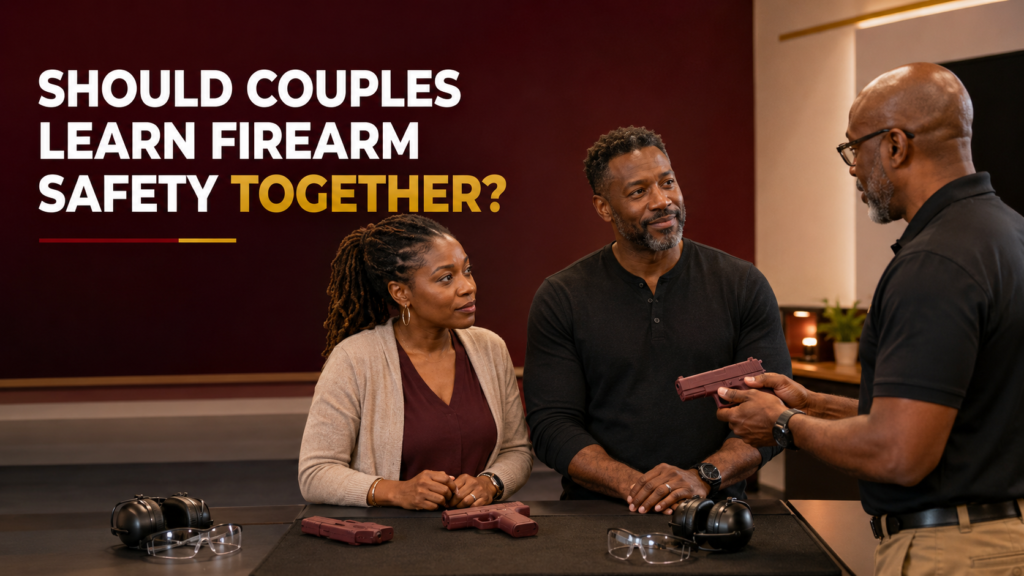
A couple walks into firearm training together.
One partner has watched countless videos, follows several firearm instructors online, and has already practiced holding an unloaded handgun at home. They feel prepared. Maybe even a little advanced.
The other partner is nervous.
They are thinking about the sound, the mechanics, the safety rules, and whether everyone else will know more than they do. Most of all, they do not want to be corrected, teased, rushed, or treated like the nervous one for the entire class.
Both people want the same thing: to learn how to handle a firearm safely.
But if they are not careful, one person’s confidence can become the other person’s pressure.
That is why couples should absolutely learn firearm safety together. Friends, relatives, and small groups should too. They simply need to do it in a setting where a qualified instructor leads the instruction and everyone is allowed to learn at their own pace.
What the Confident Partner Thinks
“I’m just trying to help.”
They have already learned a few terms, watched demonstrations, and formed opinions about what works. When they whisper a correction or reposition their partner’s hands, they believe they are making the lesson easier.
What the Nervous Partner Experiences
“I cannot make a mistake without being watched.”
Now they are listening to the instructor while also anticipating commentary from the person beside them. Instead of concentrating on the safety lesson, they are trying not to look confused.
What the Confident Partner Thinks
“They will feel better once they try it.”
The confident partner wants to move things along. They may encourage the other person to pick up the training firearm, try the simulator, or repeat a skill before that person feels ready.
The intention is usually supportive.
What the Nervous Partner Experiences
“I said I needed a minute, but apparently we are on somebody else’s schedule.”
Encouragement starts feeling like pressure. The nervous partner may continue even though they are overwhelmed because they do not want to disappoint the group or hold up the class.
That is not how confidence is built.
What the Confident Partner Thinks
“I already showed them how to do this at home.”
They may feel frustrated when their partner uses a different grip, forgets a step, or asks the instructor a question that has already been discussed between them.
What the Nervous Partner Experiences
“I have two instructors, and they are telling me different things.”
A more experienced partner is not automatically a qualified firearm instructor. Watching videos, owning a firearm, visiting the range, or being the family’s resident gun person does not necessarily prepare someone to teach another person safely.
Good intentions matter, but training, communication, observation, and the ability to correct safely matter too.
When you attend class together, your job is to be your partner’s support system. Let the instructor be the instructor.
Why Learning Firearm Safety Together Can Be a Great Idea
Firearm safety affects everyone in a household, not only the person who owns or carries the firearm.
Learning together can help couples and families:
- Establish shared expectations for safe handling and storage
- Use consistent firearm safety language at home
- Understand each person’s comfort level
- Ask questions in a structured environment
- Make informed decisions about future training
- Build confidence without relying on guesswork
It can also reveal where your knowledge differs. One person may be comfortable discussing firearm parts but unsure about safe storage. Another may understand the safety rules but need more time with grip, stance, loading, or unloading.
Different starting points are normal. They are not a problem that one partner needs to fix before class.
Five Rules for Training Well Together
1. Let the Instructor Instruct
This is the big one.
Do not whisper corrections while the instructor is talking. Do not reach over and adjust someone’s grip, stance, hands, or equipment unless the instructor specifically directs you to assist.
If you notice something that concerns you, get the instructor’s attention.
This keeps the instruction consistent and prevents your partner from trying to process two sets of directions at once. It also protects your relationship from turning firearm class into an extremely tense version of couples trivia.
You came to learn together, not to audition for assistant instructor.
2. Do Not Compare Progress
One person may understand the mechanics quickly. The other may be more consistent with the safety rules. Someone may feel comfortable during classroom practice and become nervous when range time is introduced.
Progress will not always look the same.
Avoid comments such as:
- “I got it on the first try.”
- “You are overthinking it.”
- “We practiced this already.”
- “Everybody else is doing it.”
- “It is not that hard.”
Instead, focus on whether each person is learning safely and becoming more comfortable than when they arrived.
The goal is not to determine who is the natural shooter. The goal is to create two safer, better-informed people.
3. Agree That Either Person Can Pause
Before training begins, agree that either person can say, “I need a minute,” without being questioned, teased, or pushed.
A pause may be needed because someone:
- Does not understand an instruction
- Feels physically uncomfortable
- Is becoming mentally overwhelmed
- Needs hearing or eye protection adjusted
- Wants the instructor to demonstrate the skill again
- Is not ready to continue to the next step
Pausing is not failing. In firearm training, recognizing when you need clarification or a reset is part of responsible decision-making.
4. Use the Same Safety Language
Couples and family members often create shorthand at home. That may be fine for deciding who is picking up dinner. It is less helpful when handling firearms.
Use the clear, consistent safety language taught by your instructor. Everyone should understand terms related to muzzle direction, trigger-finger placement, loading, unloading, firearm condition, and range commands.
If one person says “safe,” everyone should understand exactly what that means in that situation.
Shared language reduces confusion. It also makes future practice more structured and helps keep safe handling habits consistent at home.
5. Debrief With Curiosity, Not Criticism
After class, talk about what each person learned.
Try questions such as:
- “What part made you feel most comfortable?”
- “Was anything different from what you expected?”
- “What would you like to practice again?”
- “Do you want our next step to be another class or private coaching?”
- “What questions do we still have?”
Avoid beginning the ride home with a full performance review.
The person who was nervous already knows they were nervous. They do not need a list of everything you noticed. Give them room to describe the experience in their own words.
When a Public Couples Beginner Class Is a Good Fit
A public couples beginner handgun class can be an excellent choice when both people want a structured introduction to firearm safety and handgun fundamentals.
It may be a good fit if:
- Both participants are beginners or have limited formal training
- Each person can follow instruction in a shared classroom
- You want to learn alongside other couples
- You are comfortable asking questions in a public class
- You want a supportive introduction without jumping directly into advanced skills
- You can respect different learning speeds without coaching each other
Tribe Defense Academy’s beginner training is designed to be welcoming, practical, and judgment-free. Nobody needs to arrive pretending they already know what they are doing.
That is the reason you are coming to class.
When Customized Private Group Training May Be Better
A private group class may be the better choice when your group has mixed experience levels, specific learning goals, scheduling needs, or participants who would benefit from a more personalized pace.
Consider private group training if:
- One participant is highly experienced and another is completely new
- Someone has significant anxiety around firearms
- Your group has many questions about a particular topic
- You want training for a family, organization, or private celebration
- Participants need additional time or accessibility accommodations
- Your group wants permit training together
- Range coaching may be appropriate after foundational instruction
- You prefer a private learning environment
Private does not mean informal. It does not mean safety rules become optional or that the group gets to direct the instructor.
It means Tribe can structure the experience around your group’s starting point and goals while maintaining all safety procedures, eligibility requirements, and instructor standards.
Firearm Safety Training Is Not Just for Couples
Group firearm training can work well for people who already trust one another and want to build a shared foundation.
Women’s Groups
A private women’s beginner class can create space for honest questions without pressure or judgment. It can be especially helpful when some participants are curious, some are nervous, and one friend has been trying to get everyone into a class for the last six months.
Yes, we know there is usually one organizer.
Friend Groups
Friends can learn together while still receiving individual instruction. Nobody has to pretend to be experienced just because someone else in the group owns a firearm.
Families and Relatives
Family training can help establish consistent expectations around firearm safety, responsible handling, storage, and communication. The exact format should be chosen based on participant ages, experience, and training goals.
Coworkers and Community Organizations
Organizations may arrange private firearm safety education as part of a broader personal-safety initiative. Training can be customized around the group’s needs without turning the class into a one-size-fits-all lecture.
Private Celebrations
Birthday gatherings, couples’ activities, reunions, and other private events can include meaningful, beginner-friendly firearm education. It can be fun, but it is still training. All safety requirements and instructor directions remain in place from beginning to end.
Whatever brings the group together, the standard stays the same: safe instruction, appropriate supervision, clear expectations, and respect for every participant’s comfort level.
Choose Your Group Format
| Training format | Best for | What to consider |
|---|---|---|
| Public beginner class | Couples, women, friends, or individuals seeking a structured introduction with other beginners | Best when participants are comfortable learning in a shared class and do not need extensive customization |
| Private group classroom class | Families, women’s groups, friends, coworkers, organizations, and private celebrations | Content and pacing may be customized around the group’s experience and goals while all safety requirements remain in place |
| Private permit class for a group | Eligible participants who want to complete the same permit-related training together | Permit requirements, required training time, documentation, and qualification standards still apply to every participant |
| Private group range coaching when appropriate | Groups ready for supervised live-fire instruction or focused skill development | Suitability depends on experience, group goals, range conditions, instructor approval, and completion of any recommended foundational training |
Not sure which format fits? You do not have to diagnose your entire group before calling. Tell Tribe who is coming, what they know, and what you hope to accomplish. We will help determine the safest and most useful starting point.
Checklist for Organizing a Private Firearm Training Group
Before contacting Tribe Defense Academy, gather the following information:
- Group size: How many people are interested?
- Experience: Has anyone completed formal firearm training? Is anyone completely new?
- Goals: Are you seeking beginner safety education, permit training, skill development, or range coaching?
- Preferred dates: What days and general times work for most participants?
- Classroom versus range needs: Are you looking for classroom instruction, live-fire coaching, or guidance on the appropriate sequence?
- Accessibility concerns: Does anyone need physical accommodations, additional processing time, seating considerations, or other support?
Please also mention significant differences in experience or confidence. That information helps us create a better training plan. It is not used to judge anyone.
Learn Together Without Putting Pressure on Each Other
Yes, couples should learn firearm safety together.
So should sisters, best friends, relatives, coworkers, neighbors, and community groups.
But learning together works best when nobody is expected to keep up with the most confident person in the room. One participant should not become the unofficial instructor simply because they have watched more videos, visited the range more often, or owned a firearm longer.
Come as a team. Support each other. Ask questions. Take pauses when needed.
Then let a qualified instructor lead the training.
Ready to begin?
Register for an upcoming Couples Beginner Handgun Class or view upcoming women’s beginner firearm training.
Want a private experience for your couple, family, women’s group, organization, or celebration? Call or text Tribe Defense Academy at 301-410-9220 to arrange private group training.
Protect your peace. Protect yourself. Protect your tribe.
Frequently Asked Questions
Should couples take a firearm safety class together?
Yes. Training together can help couples develop shared safety language, understand each other’s comfort levels, and make informed decisions about firearm ownership and future practice. Both partners should be allowed to learn at their own pace.
Can my experienced partner teach me firearm safety?
An experienced partner can support your learning, but experience does not automatically make someone a qualified instructor. Formal training provides structured instruction, consistent safety language, supervised practice, and professional correction.
What if one partner is comfortable with firearms and the other is nervous?
That is common. A beginner-friendly class or customized private session allows an instructor to account for different experience and confidence levels. The more confident partner should avoid correcting, rushing, or comparing the nervous participant.
Can friends or relatives attend firearm training together?
Yes. Friends, relatives, women’s groups, families, coworkers, and community organizations may learn together through an appropriate public class or customized private group format.
Can a private firearm class be customized?
Private group training can be structured around the group’s experience, goals, schedule, and appropriate classroom or range needs. Required safety procedures, instructor directions, permit requirements, and range rules still apply.
Is range training appropriate for every beginner group?
Not always as the first step. The appropriate starting point depends on the group’s experience, comfort level, and goals. Tribe can recommend whether classroom instruction, simulator practice, permit training, or supervised range coaching should come first.